
From a Post-it Note to a Time Capsule
Why I’m choosing print, presence, and paying attention over constant updating.
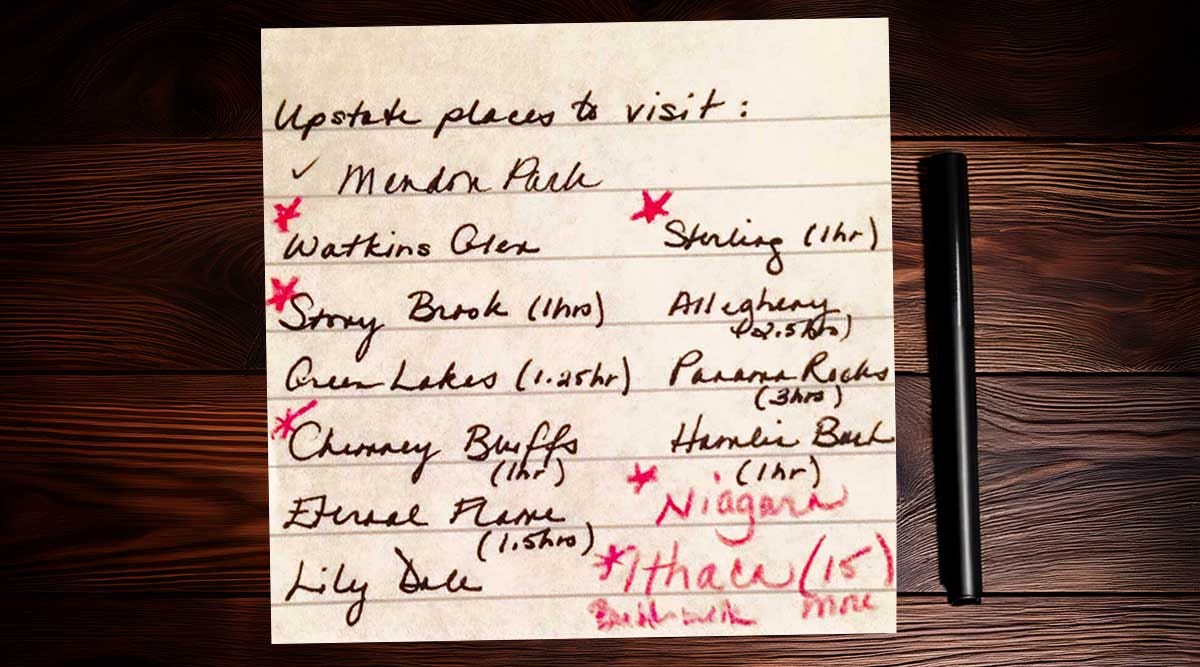
Day Trips Around Rochester began as a simple, human gesture. A coworker was new to the city, and I was trying to help them explore the region. I suggested a short list of places, which they wrote on a Post-it note—nothing polished, just the kind of things you share when someone asks, “Where should I go this weekend?”
I’ve lived in Rochester my whole life, but writing those places down made me see them differently. What felt familiar to me was intriguing to someone else. Sharing became a way to engage with the world—and a motivation to leave my house, meet people, and seek out new places to experience, notice, and eventually share them.
I’m a web designer—both in my day job and through Day Trips Around Rochester—and much of that work involves maintaining a social media presence. I’ve also been photographing places for as long as I can remember. Pairing those photographs with short, place-based descriptions felt like a natural extension of what I was already doing, and it gave shape to the first web guides. Building the site was a welcome challenge. It was creative, practical, and generous. It felt like helping people feel at home.
After 2020, something shifted. After months apart, tethered to screens, people were craving analog, offline ways to reconnect—and the community urged me to write it down again, this time as a book. I hesitated. I was a digital designer—what did I know about making a book?
Soon after, I listened to a conversation between Arthur Frommer and Rick Steves that helped clarify my thinking. They described travel guidebooks as time capsules—records of places as they exist in a particular moment. Borders shift. Businesses open and close. Landscapes change. Cultures evolve. Even the most practical guides, they noted, quietly become historical documents simply by existing.
That idea was the catalyst that led me to pursue the book—and the permission I needed to stop being afraid of impermanence. A book gives me a way to acknowledge it without trying to outrun it. A book, like a photograph, captures a moment as it happens. Once it exists, there’s no undo—only the record of what was. I’m documenting how Rochester looks and feels now, as I experience it—not to be paralyzed by change over time, but to make peace with it.
The web can always be updated. A book can’t—and that’s part of its value. Print asks for brevity and commitment. It requires me to think more deeply about a place, choosing words deliberately when I can’t simply link elsewhere and ask the reader to learn more. What’s on the page has to be enough.
It also asks me to accept that what I’m recording may soon change. A historic restaurant might close before the ink is fully dry. A new place may open before the book ever finds its reader. Or I may learn about something I never knew—offered with the same generosity as that first Post-it note.
That same book might sit on someone’s bookshelf for years before they read it—pulled down on a quiet afternoon, opened long after the moment it describes has passed. In that way, a book can feel outdated almost as soon as it’s printed, yet still hold meaning—as a reflection of what once existed.
That’s the paradox I’ve come to appreciate. The book isn’t promising permanence or accuracy forever. It’s offering a record: this is how this place looked and felt at this moment in time. An artifact.
I still enjoy sharing day-trip ideas. I like the spark that comes when someone says, “I’ve lived here my whole life and never knew that existed.” That part hasn’t gone away.
What has changed is how that sharing moves through the world. Everything now feels filtered and flattened by algorithms that reward urgency, novelty, and repetition. Places become content. Experiences get packaged. Even sincerity starts to feel optimized.
It’s not lost on me that I’m writing this on a screen for a screen. For now, this is where the conversation lives.
Today, I’m working on more print books, and the balance feels right. My earlier books were closely tied to the web; the ones I’m working on now feel more self-contained and more intentional, guided less by click rates and more by creativity and self-expression. I spend less time feeding the churn and more time creating something lasting—work that gently encourages others to close the app, leave the house, and reenter the world.
Sharing still matters to me. I’m just choosing to do it in ways that feel more human.
Well said. Totally agree. Print vs feeding the churn.